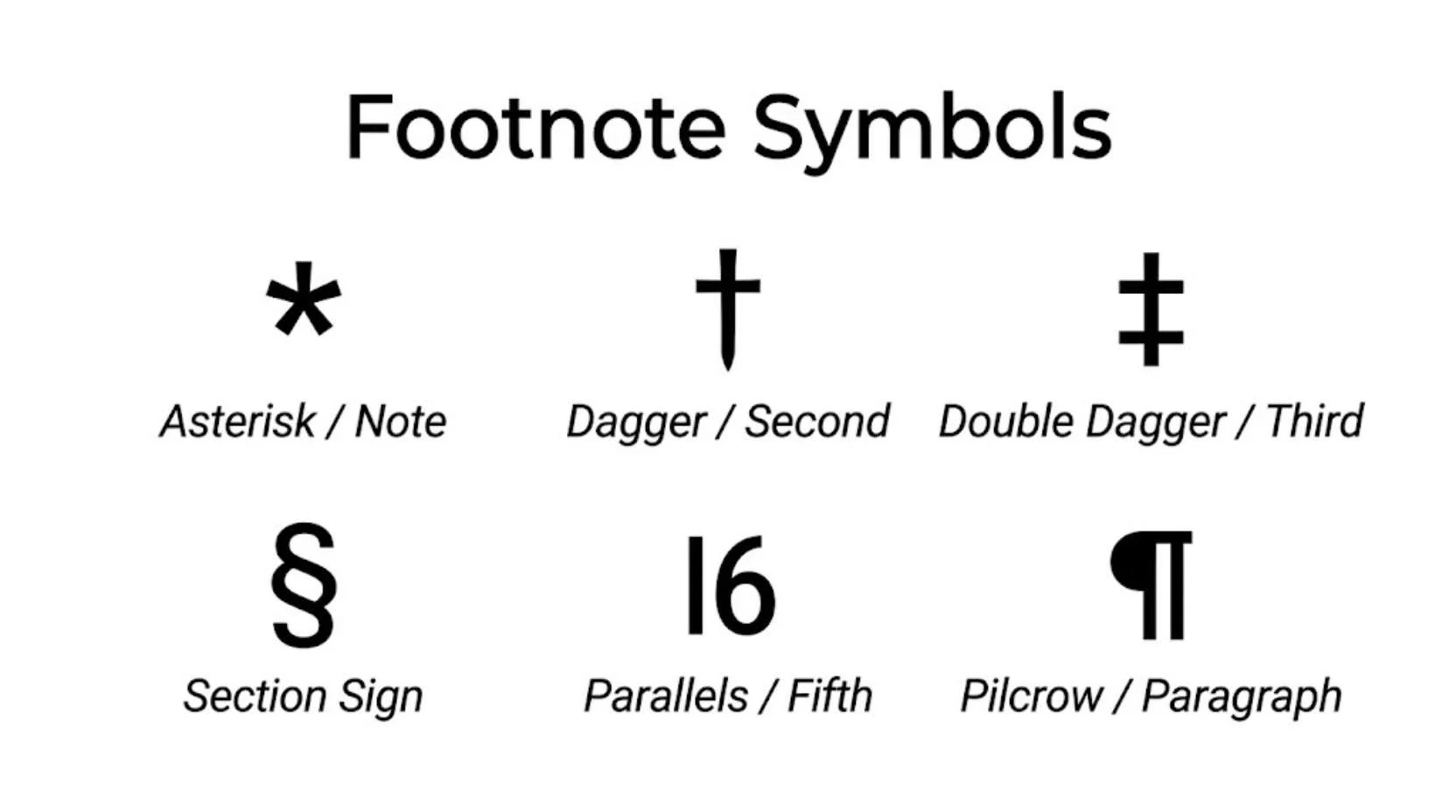
Footnote symbols appear so often in books, research papers, legal documents, websites, and academic writing that most people barely notice them.
Yet these tiny marks carry a surprisingly important role in communication. From the familiar asterisk (*) to the mysterious dagger (†), footnote symbols help readers find additional information without interrupting the flow of a text.
Throughout history, footnote symbols have guided readers, preserved knowledge, and connected ideas across generations. They are more than simple punctuation marks. They represent organization, authority, reference, and intellectual curiosity. Understanding footnote symbols can help you read, write, and interpret information more effectively.
In this guide, you’ll discover the meanings, origins, cultural significance, common uses, and hidden stories behind footnote symbols. You may never look at these tiny symbols the same way again.
Quick Answer
Footnote symbols are special marks used to direct readers to additional information, explanations, citations, or references found elsewhere on a page or document. Common footnote symbols include the asterisk (*), dagger (†), double dagger (‡), section sign (§), and paragraph mark (¶). They help organize information while keeping the main text clear and easy to read.
What Are Footnote Symbols?
Footnote symbols are typographic marks placed within a text to indicate that additional information is available in a footnote or note section.
Instead of placing lengthy explanations directly into a paragraph, writers use symbols to guide readers to supporting details.
Common purposes include:
- Providing references and citations
- Adding extra explanations
- Clarifying statements
- Giving historical context
- Including legal notes
- Offering translations or definitions
These symbols act as visual bridges between the main text and supplemental information.
Why Footnote Symbols Matter
Footnote symbols help maintain readability while preserving valuable details.
Without them:
- Pages would become cluttered
- Academic writing would be difficult to follow
- Legal documents could become confusing
- Historical references might be lost
In many ways, footnote symbols are silent guides that improve communication.
What Makes Something a Footnote Symbol?
Not every punctuation mark qualifies as a footnote symbol.
A true footnote symbol performs three important functions:
It Directs Attention
The symbol immediately signals that more information exists elsewhere.
It Creates a Connection
The mark links the main text with a specific note.
It Saves Space
Instead of interrupting the reader with long explanations, the symbol keeps the content organized.
A successful footnote symbol is small, recognizable, and easy to distinguish from ordinary punctuation.
Most Famous Footnote Symbols and Their Meanings
Asterisk (*)
The asterisk is the most recognized footnote symbol in the world.
Meaning:
- Additional information
- Special note
- Important clarification
- Citation reference
Historical Origin:
The asterisk dates back to ancient Greek scholars who used it to highlight notable passages.
Psychological Meaning:
The asterisk attracts attention and suggests that something important should not be overlooked.
Dagger (†)
The dagger symbol is often the second footnote marker after the asterisk.
Meaning:
- Secondary note
- Historical annotation
- Additional citation
In genealogy and historical records, it may also indicate death dates.
Psychological Meaning:
The dagger creates a sense of seriousness and significance.
Double Dagger (‡)
When more footnotes are needed, writers often use the double dagger.
Meaning:
- Third footnote reference
- Additional supporting information
The double dagger is common in academic journals and scholarly publications.
Section Sign (§)
The section sign appears frequently in legal documents.
Meaning:
- Reference to a specific section
- Legal citation
- Structured organization
Lawyers and researchers regularly use this symbol to navigate complex texts.
Paragraph Mark (¶)
Also known as the pilcrow.
Meaning:
- Paragraph reference
- Editorial notation
- Text organization
Editors have used this symbol for centuries to indicate paragraph divisions.
Number Sign (#)
Although often used as a hashtag today, it sometimes functions as a reference symbol.
Meaning:
- Note indicator
- Cross reference
- Catalog identifier
A Quick Comparison of Common Footnote Symbols
| Symbol | Name | Common Use |
| * | Asterisk | First footnote |
| † | Dagger | Second footnote |
| ‡ | Double Dagger | Third footnote |
| § | Section Sign | Legal references |
| ¶ | Paragraph Mark | Paragraph references |
| # | Number Sign | Additional notation |
Animal and Nature Symbols Related to Guidance and Reference
Footnote symbols themselves are not animals or natural objects, but many cultures associate guidance and knowledge with certain natural symbols.
Owl
The owl symbolizes wisdom and hidden knowledge.
Just as footnote symbols reveal extra information, owls represent deeper understanding.
Raven
Many traditions view ravens as messengers between worlds.
Like footnotes, ravens connect one source of knowledge to another.
Tree of Knowledge
The tree symbolizes interconnected information and learning.
Footnotes create similar connections within written texts.
Stars
Asterisks resemble stars.
This connection explains why the asterisk naturally attracts attention and highlights important information.
Objects and Actions That Represent Footnote Symbols
Several objects reflect the purpose and meaning of footnote symbols.
Bookmark
A bookmark directs readers to a specific location, much like a footnote symbol.
Compass
Footnote symbols guide readers toward additional information.
Key
A key unlocks hidden knowledge.
Footnotes reveal details that might otherwise remain unseen.
Bridge
A bridge connects two places.
Footnote symbols connect main content with supporting material.
Signpost
Like road signs, footnote symbols point readers in the right direction.
Ancient and Cultural History of Footnote Symbols
Ancient Greece
Greek scholars developed some of the earliest annotation systems.
They used symbols similar to modern asterisks to identify important passages in manuscripts.
Ancient Rome
Roman writers expanded annotation methods and introduced more structured referencing systems.
Medieval Europe
Monks copying manuscripts used marks and symbols to add comments and corrections.
These annotations eventually evolved into modern footnotes.
Renaissance Scholarship
As printing expanded across Europe, scholars needed standardized methods for citations.
Footnote symbols became increasingly common.
Modern Academic Culture
Universities around the world rely on footnote systems for research and scholarly integrity.
Today, footnote symbols serve as universal tools of knowledge.
Footnote Symbols Across Different Cultures
United States
American academic writing commonly uses numbered footnotes, though symbols still appear in tables, charts, and legal texts.
Europe
Many European publishers continue using traditional footnote symbols, especially in historical works.
Asia
Asian academic institutions often combine numerical citations with traditional annotation systems.
Africa
Educational publications frequently use footnote symbols in multilingual documents to provide translations and explanations.
Despite regional differences, the purpose remains the same: connecting readers to additional information.
Spiritual Meaning and Deeper Interpretation of Footnote Symbols
At a symbolic level, footnote symbols represent much more than references.
Hidden Knowledge
A footnote reminds us that deeper layers of understanding often exist beneath the surface.
Humility
Footnotes acknowledge that a statement may need explanation or supporting evidence.
Curiosity
They encourage readers to explore beyond what is immediately visible.
Connection
Every footnote creates a relationship between ideas.
Wisdom
The search for supporting information reflects humanity’s desire for truth and understanding.
Many philosophers see footnotes as symbols of intellectual exploration.
Symbolism of Footnote Symbols in Literature
Authors often use footnotes creatively.
Expanding the Story
Some writers place additional narratives inside footnotes.
Readers discover hidden layers unavailable in the main text.
Creating Humor
Footnotes can deliver jokes, side comments, and playful observations.
Building Realism
Detailed footnotes can make fictional worlds feel authentic.
Encouraging Investigation
Readers become active participants by following references and exploring connections.
Famous Literary Use
The acclaimed novel House of Leaves uses extensive footnotes to create mystery, complexity, and suspense.
Footnote Symbols in Everyday Life
Most people encounter footnote symbols regularly without realizing it.
Product Packaging
Important details often appear beside an asterisk.
Examples include:
- Terms and conditions
- Nutritional information
- Promotional disclaimers
Advertisements
Small print frequently connects to asterisk symbols.
Websites
Online content uses footnotes for citations and explanations.
Contracts
Legal agreements rely heavily on reference symbols.
Educational Materials
Textbooks and study guides use footnotes to support learning.
Universal and Most Recognized Footnote Symbol
Among all footnote symbols, the asterisk remains the universal champion.
Reasons include:
- Instantly recognizable
- Easy to type
- Visually distinctive
- Used worldwide
- Works across languages
For many people, the asterisk has become synonymous with “important additional information.”
Footnote Symbols and Human Psychology
Why do these tiny marks capture our attention?
Researchers suggest several reasons.
Pattern Recognition
The brain naturally notices unusual shapes.
Curiosity Trigger
Symbols suggest hidden information.
Cognitive Organization
Footnotes help readers process complex material efficiently.
Information Hierarchy
The symbols signal that some details belong outside the main narrative.
This structure reduces mental overload and improves comprehension.
Tattoo Ideas Inspired by Footnote Symbols
Surprisingly, some people choose footnote related tattoos because of their symbolic meanings.
Asterisk Tattoo
Represents:
- Important life moments
- Turning points
- Hidden stories
Dagger Tattoo
Represents:
- Remembrance
- Sacrifice
- Personal transformation
Paragraph Mark Tattoo
Represents:
- A new chapter in life
- Personal growth
- Fresh beginnings
Custom Footnote Design
Some people tattoo an asterisk paired with a meaningful quote, suggesting that there is always more to their story.
How to Create or Draw a Footnote Symbol?
Drawing common footnote symbols is simple.
How to Draw an Asterisk
- Draw a vertical line.
- Draw a horizontal line through the center.
- Add a diagonal line from top left to bottom right.
- Add another diagonal line from top right to bottom left.
How to Draw a Dagger
- Draw a vertical line.
- Add a short horizontal line near the top.
How to Draw a Double Dagger
- Draw a dagger.
- Add a second horizontal line below the first.
Design Tips
- Keep lines balanced.
- Use consistent spacing.
- Make symbols easy to recognize.
- Avoid excessive decoration.
The Future of Footnote Symbols
Digital communication continues to evolve.
Yet footnote symbols remain relevant.
Modern applications include:
- Online citations
- Hyperlinked references
- Academic databases
- E books
- Interactive research tools
As information grows more complex, the need for clear references becomes even greater.
Footnote symbols continue to help people organize knowledge in both printed and digital formats.
Frequently Asked Questions
What is the most common footnote symbol?
The asterisk (*) is the most common footnote symbol and is widely used for references, notes, and clarifications.
Why is a dagger used in footnotes?
The dagger (†) traditionally serves as the second footnote symbol after the asterisk when multiple notes appear on a page.
Are footnote symbols universal?
Most major footnote symbols are recognized globally, although citation styles can differ among countries and institutions.
What does the paragraph symbol (¶) mean?
The paragraph symbol identifies paragraph references, editorial notes, and document organization.
Can footnote symbols have symbolic meanings?
Yes. Many people associate them with knowledge, guidance, hidden information, curiosity, and intellectual exploration.
Are footnotes still important today?
Absolutely. Footnotes remain essential in academic writing, legal documents, research papers, books, and digital publishing.
Conclusion
Footnote symbols may seem small, but their impact on communication is enormous. These marks help organize information, preserve knowledge, and guide readers toward deeper understanding. From the ancient asterisk to the legal section sign, each symbol carries a unique history and purpose.
They represent curiosity, learning, connection, and the human desire to explore beyond the surface. The next time you see a footnote symbol, remember that it is far more than a tiny mark on a page. It is a doorway to additional knowledge and hidden meaning.

Ryan Scott is a dedicated writer and symbol researcher who uncovers the deeper meanings behind everyday signs and symbols. His work focuses on making complex symbolic concepts simple, engaging, and easy to understand for readers from all backgrounds.
He is the author of Hidden Symbol Codes and Secrets Behind Ancient Symbols, where he explores the origins and meanings of symbols across different cultures.
Ryan’s goal is to inspire curiosity and help readers see the world from a new perspective through the language of symbols.
 Sophia Bennett
 Andrew Clark