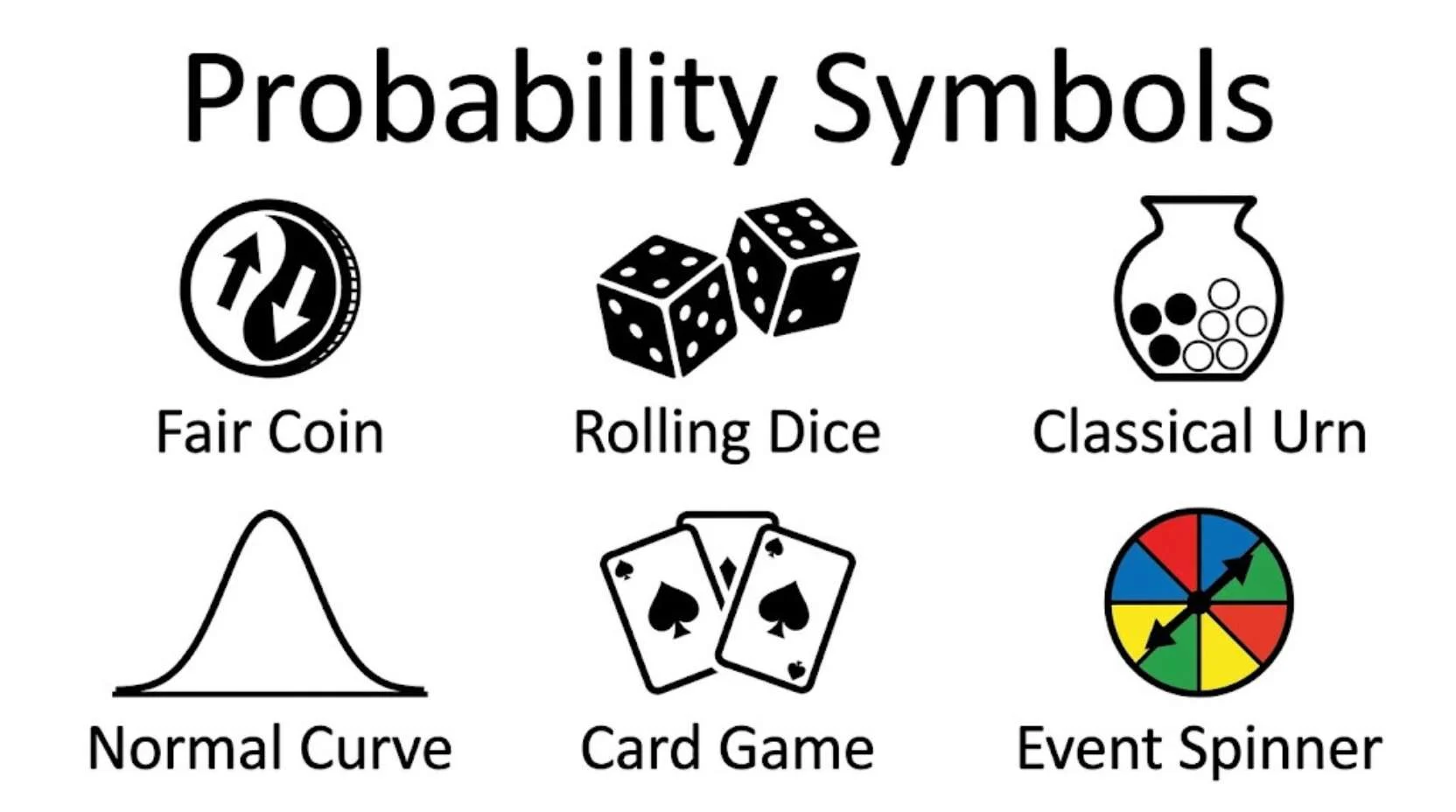
“Probability symbols” are the language of uncertainty. Every time you check the weather forecast, play a game, analyze data, or make a prediction, probability symbols help describe the chances of an event happening.
These symbols are not just mathematical shortcuts. They represent human attempts to understand risk, luck, patterns, and decision making.
From ancient gambling games to modern artificial intelligence, probability symbols have shaped how people interpret the unknown. Understanding them can make statistics easier, improve critical thinking, and reveal the fascinating logic behind chance and prediction.
This guide explores the meaning, history, uses, and deeper significance of probability symbols in a simple and engaging way.
Quick Answer
Probability symbols are mathematical signs used to represent chances, events, outcomes, and statistical relationships. The most common probability symbols include:
- P(A) = Probability of event A
- ∩ = Intersection of events
- ∪ = Union of events
- P(A|B) = Conditional probability
- Ω = Sample space
- ∅ = Empty set
- E(X) = Expected value
- μ = Mean
- σ = Standard deviation
These symbols help mathematicians, scientists, statisticians, and researchers analyze uncertainty and make predictions.
What Makes Something a Probability Symbol?
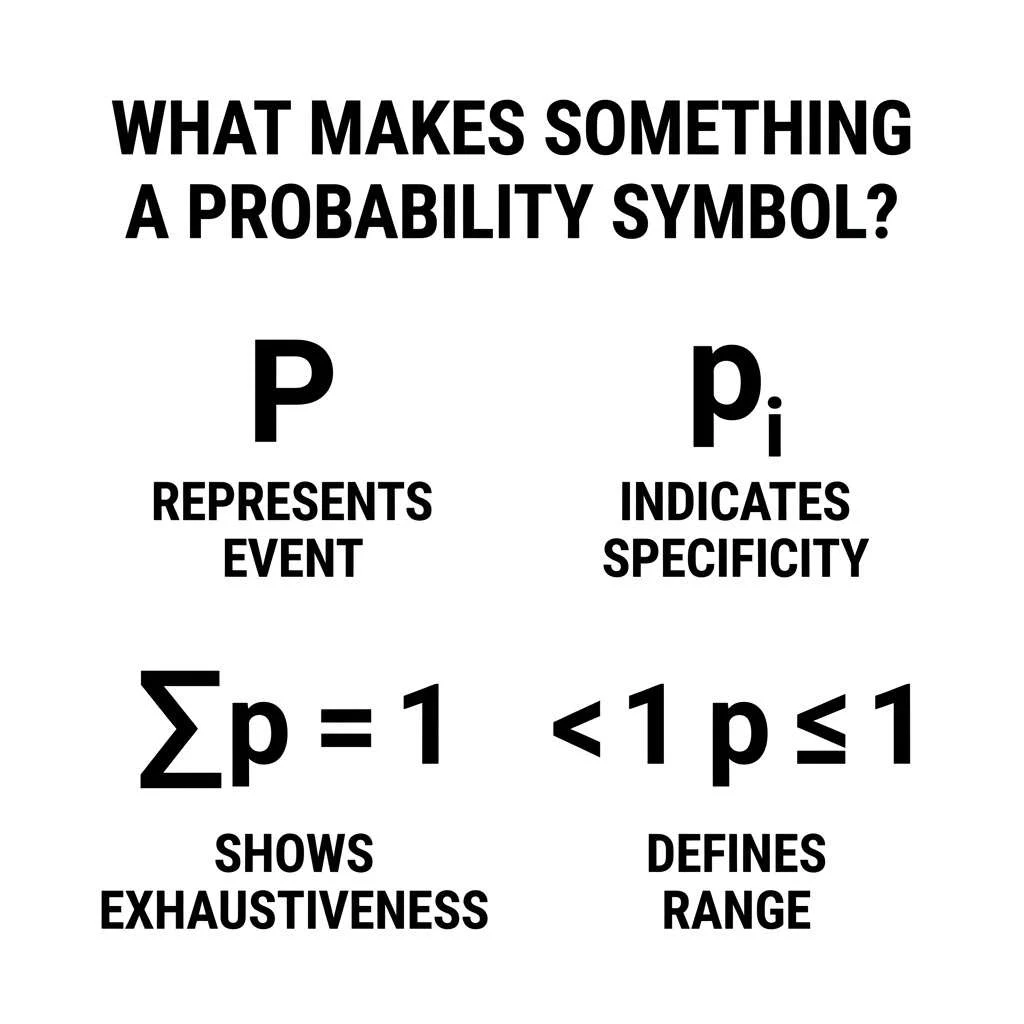
A probability symbol represents an idea, event, relationship, or numerical value connected to uncertainty and chance.
Unlike ordinary symbols that represent physical objects, probability symbols describe abstract concepts. They help people understand possible outcomes and measure likelihood.
A true probability symbol usually has three characteristics:
- It simplifies complex calculations.
- It represents a mathematical relationship.
- It communicates information universally.
For example, writing P(Rain) is much simpler than repeatedly writing “the probability that it will rain.”
Why Probability Symbols Matter
Probability symbols are important because they:
- Help predict future outcomes.
- Support scientific research.
- Improve decision making.
- Power machine learning systems.
- Assist in risk assessment.
- Simplify statistical communication.
Without these symbols, modern statistics and data science would be much harder to understand.
Most Famous Probability Symbols and Their Meanings
P(A) Symbol
The symbol P(A) means “the probability of event A.”
Example:
- P(Rain) = Chance of rain
- P(Winning) = Chance of winning
This is the most recognized probability symbol worldwide.
The Union Symbol (∪)
The union symbol represents “A or B.”
If two events can occur separately or together, the union combines them.
Example:
- A = Rolling an even number
- B = Rolling a number greater than 4
A ∪ B includes all outcomes belonging to either event.
The Intersection Symbol (∩)
The intersection symbol means “A and B.”
It identifies outcomes shared by both events.
Psychologically, this symbol represents overlap and connection between possibilities.
Conditional Probability Symbol P(A|B)
This symbol means:
“Probability of A given that B has already occurred.”
It is one of the most powerful concepts in statistics.
Example:
- Probability of carrying an umbrella given that it is raining.
This symbol helps people make informed decisions using available information.
Omega Symbol (Ω)
Ω represents the sample space.
The sample space contains every possible outcome.
Example:
Rolling a die:
Ω = {1,2,3,4,5,6}
This symbol represents completeness and total possibility.
Empty Set Symbol (∅)
The symbol ∅ means no possible outcomes.
Example:
Getting a number greater than 10 on a standard die.
Since this is impossible:
∅
This symbol represents impossibility.
Essential Probability Symbols Table
| Symbol | Meaning | Example |
| P(A) | Probability of event A | P(Rain) |
| ∪ | Union | A or B |
| ∩ | Intersection | A and B |
| Ω | Sample Space | All outcomes |
| ∅ | Empty Set | Impossible event |
| P(A|B) | Conditional Probability | Given B |
| E(X) | Expected Value | Average outcome |
| μ | Mean | Average |
| σ | Standard Deviation | Spread of data |
| X | Random Variable | Measured value |
Objects and Actions That Represent Probability
Probability often appears through physical objects and actions.
Dice
Dice are among the oldest symbols of probability.
They represent:
- Chance
- Randomness
- Risk
- Prediction
Ancient civilizations used dice thousands of years ago, long before modern probability theory existed.
Coins
A coin flip symbolizes uncertainty.
Possible outcomes:
- Heads
- Tails
Because each outcome has equal likelihood, coins became classic teaching tools for probability.
Playing Cards
Cards symbolize calculated probability.
Unlike dice, cards allow people to track changing odds as cards are removed from the deck.
Roulette Wheels
Roulette wheels visually demonstrate randomness and probability.
Many people associate them with:
- Gambling
- Fortune
- Risk assessment
Lottery Tickets
Lottery tickets symbolize extremely low probability events.
They remind people that unlikely outcomes can still happen.
Animal and Nature Symbols Related to Probability
Probability itself does not have official animal symbols. However, several animals and natural phenomena commonly represent uncertainty, chance, and unpredictability.
Butterfly
Butterflies symbolize unpredictability.
This idea inspired the famous “Butterfly Effect” in chaos theory.
Small changes can create large future consequences.
Raven
In folklore, ravens often symbolize mystery and uncertain outcomes.
Their appearance was sometimes interpreted as a sign of unknown possibilities.
Fox
Foxes symbolize strategic thinking.
Since probability often involves evaluating risks and outcomes, foxes became associated with calculated decisions.
Weather Patterns
Clouds, storms, and changing weather symbolize probability in everyday life.
Weather forecasts rely heavily on probability models.
For example:
- 70% chance of rain
- 30% chance of snow
Nature constantly demonstrates probabilistic behavior.
Ancient and Cultural Symbols of Probability
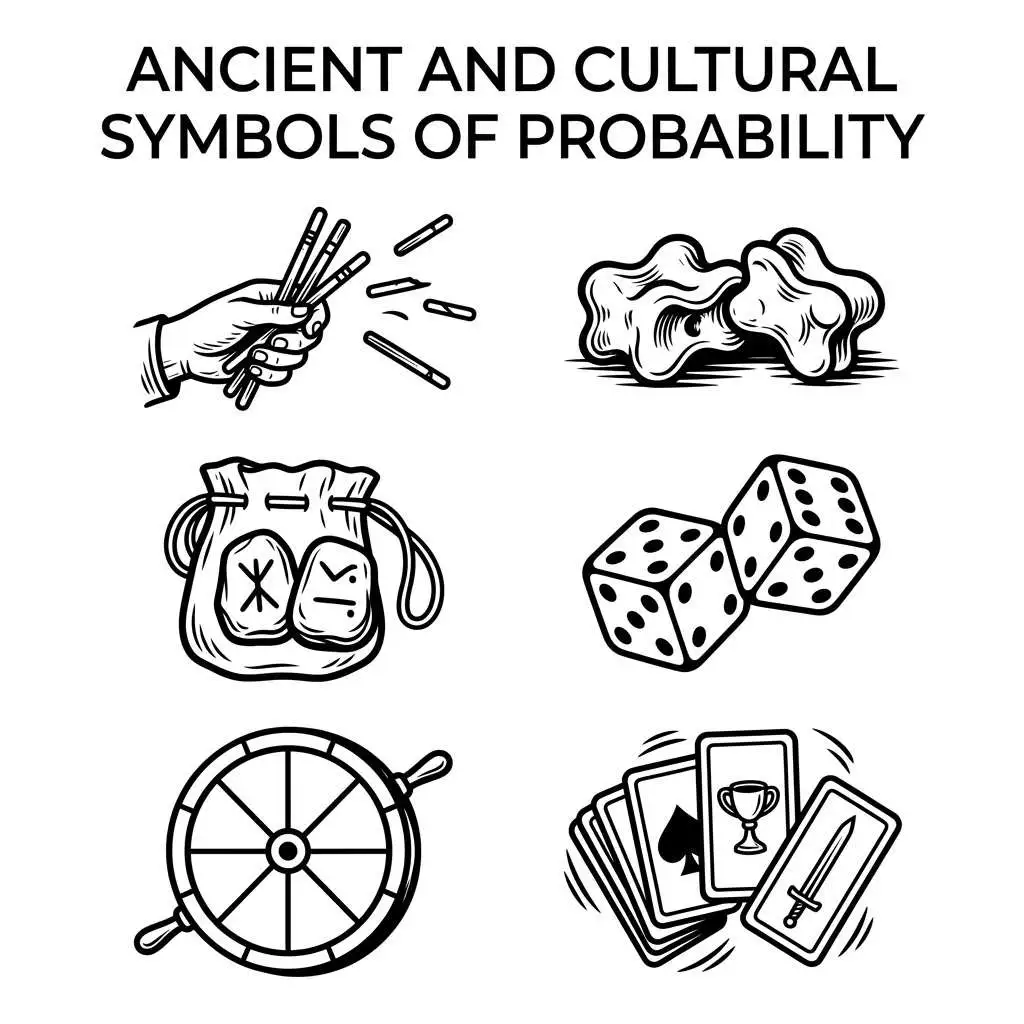
The formal study of probability began relatively recently, but many cultures developed symbolic representations of chance and fate.
Ancient Roman Dice
Romans frequently used dice in games and decision making.
Dice became one of history’s earliest visual symbols of probability.
Chinese Fortune Symbols
Ancient Chinese traditions often combined chance and destiny.
Various fortune sticks and divination tools represented uncertain outcomes.
African Divination Systems
Several African cultures developed symbolic systems involving shells, stones, or carved objects.
These systems explored future possibilities and probabilities through symbolic interpretation.
European Gambling Traditions
European gambling houses played a major role in probability’s development.
Many foundational probability theories emerged from attempts to understand games of chance.
Indigenous Symbolism
Many Indigenous traditions used natural signs to predict outcomes.
Animal movements, weather changes, and environmental patterns often served as probability indicators.
The Spiritual Meaning Behind Probability Symbols
Beyond mathematics, probability symbols can carry deeper symbolic meanings.
Possibility
Probability reminds people that multiple futures may exist.
Life rarely follows a single predictable path.
Hope
Even small probabilities create hope.
A difficult situation today can improve tomorrow.
Uncertainty
Probability symbols acknowledge uncertainty instead of pretending certainty exists.
This perspective encourages humility and open minded thinking.
Balance
Probability balances optimism and realism.
It allows people to evaluate opportunities while understanding risks.
Trust in Process
Many spiritual traditions emphasize accepting uncertainty.
Probability symbols reflect the reality that not everything can be controlled.
Probability Symbols in Literature and Culture
Writers often use probability themes to create suspense and meaning.
Chance Encounters
Many stories begin with improbable meetings.
Authors use chance to explore destiny and coincidence.
Games of Fate
Literature frequently uses dice, cards, and lotteries as symbols of uncertainty.
Examples often involve:
- Risk
- Luck
- Destiny
- Human choice
Mystery Novels
Mystery stories depend heavily on probability.
Readers constantly evaluate possible suspects and outcomes.
Modern Films
Movies often use probability concepts in plots involving:
- Gambling
- Artificial intelligence
- Time travel
- Strategic planning
Probability symbols help audiences understand complex decisions.
Symbols of Probability in Everyday Life
Most people use probability without realizing it.
Weather Apps
Every weather forecast uses probability symbols and calculations.
Examples:
- 20% chance of rain
- 80% chance of sunshine
Sports Predictions
Sports analysts constantly estimate probabilities.
Questions include:
- Who will win?
- What is the chance of scoring?
- How likely is an upset?
Medical Decisions
Doctors use probability to assess:
- Disease risks
- Treatment effectiveness
- Recovery rates
Financial Markets
Investors evaluate probabilities daily.
Every investment decision involves uncertainty.
Artificial Intelligence
Modern AI systems rely heavily on probability models.
Predictive algorithms use probabilities to:
- Recommend products
- Translate languages
- Recognize images
- Generate content
Universal Probability Symbols
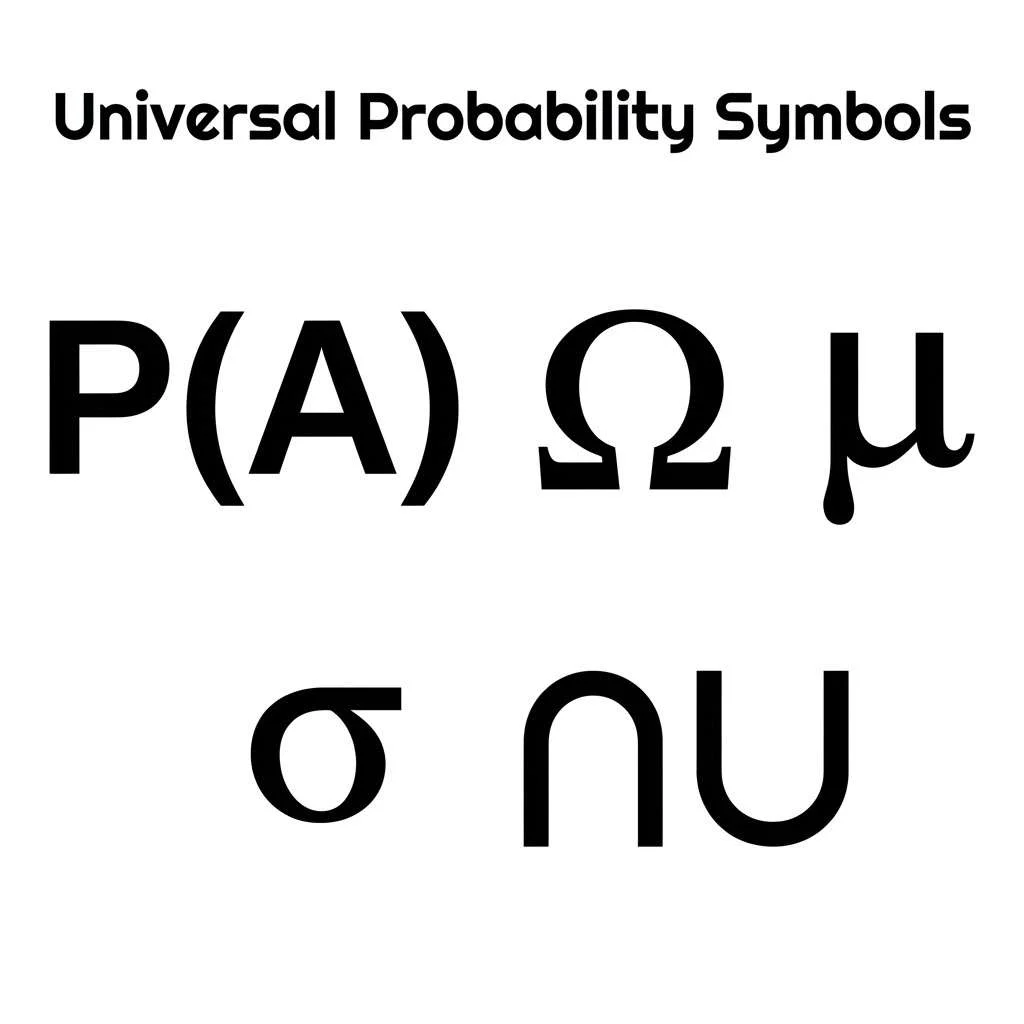
Several symbols are understood by statisticians across different countries.
P(A)
The universal symbol for probability.
Ω
The standard symbol for sample space.
μ
The universal symbol for mean.
σ
The global symbol for standard deviation.
∩ and ∪
These symbols are recognized in mathematics worldwide.
Because probability symbols are universal, researchers from different cultures can communicate efficiently.
How to Create or Draw a Probability Symbol?
Creating a probability related symbol is easier than many people think.
Step 1: Start with a Circle
A circle often represents all possible outcomes.
This mirrors the sample space concept.
Step 2: Divide Into Sections
Add regions representing different events.
This creates a visual probability model.
Step 3: Add Event Labels
Use letters such as:
- A
- B
- C
These labels identify events.
Step 4: Include Connections
Add overlapping regions to represent intersections.
Step 5: Add Probability Values
Assign percentages or fractions.
Examples:
- 25%
- 50%
- 75%
Personal Symbol Ideas
You can create a personalized probability symbol using:
- Dice imagery
- Coin designs
- Circular patterns
- Interconnected paths
- Statistical curves
These designs can represent life’s uncertainty and possibilities.
Probability Symbol Tattoo Ideas and Personal Meanings
Probability inspired tattoos are becoming increasingly popular among mathematicians, statisticians, scientists, and data enthusiasts.
P(A) Tattoo
Meaning:
- Belief in possibilities
- Embracing uncertainty
- Open minded thinking
Dice Tattoo
Meaning:
- Taking chances
- Courage
- Adventure
Infinity and Probability Combination
Meaning:
- Endless possibilities
- Multiple futures
Bell Curve Tattoo
Meaning:
- Balance
- Statistics
- Understanding life patterns
Conditional Probability Tattoo
P(A|B) can symbolize:
- Context matters
- Decisions depend on circumstances
- Life is interconnected
These tattoos often carry intellectual and personal significance.
Probability Symbols Across Different Cultures
United States
Probability symbols are strongly associated with statistics, finance, and technology.
Europe
European culture has deep historical connections to probability through mathematics and gambling theory.
Asia
Many Asian cultures blend concepts of chance, destiny, and probability.
Modern educational systems widely use probability symbols in science and engineering.
Africa
Traditional symbolic systems often explored uncertainty through divination and observation of natural patterns.
Global Perspective
Today, probability symbols form a universal mathematical language understood around the world.
Why Humans Are Fascinated by Probability
Humans naturally seek patterns.
Probability helps explain uncertainty without removing mystery entirely.
Psychologists believe people are fascinated by probability because it sits between two extremes:
- Complete certainty
- Complete chaos
Probability provides a framework for understanding the unknown.
It allows people to make decisions, evaluate risks, and imagine future possibilities.
This balance between logic and uncertainty makes probability symbols powerful and enduring.
Frequently Asked Questions
What is the most common probability symbol?
The most common probability symbol is P(A), which represents the probability of an event occurring.
What does Ω mean in probability?
Ω represents the sample space, containing all possible outcomes of an experiment.
Why are probability symbols important?
They simplify complex calculations, improve communication, and help people analyze uncertainty.
What does P(A|B) mean?
It represents conditional probability, meaning the probability of event A occurring after event B has occurred.
Are probability symbols used outside mathematics?
Yes. They are widely used in science, economics, medicine, artificial intelligence, sports analytics, and finance.
Can probability symbols have personal meanings?
Yes. Many people view them as symbols of possibility, hope, uncertainty, decision making, and life’s unpredictable nature.
Conclusion
Probability symbols are far more than mathematical notation. They represent humanity’s ongoing effort to understand uncertainty, predict outcomes, and make better decisions. From dice and coins to advanced statistical formulas, these symbols help explain how chance influences everyday life.
They appear in science, technology, finance, medicine, and even personal philosophy. By understanding probability symbols, you gain a deeper appreciation for the hidden patterns that shape the world around you and the countless possibilities that lie ahead.

Sophia Bennett is a passionate writer and symbol researcher who explores the deeper meanings behind ancient and modern symbols. With a strong interest in hidden messages, spiritual signs and cultural symbolism, she helps readers understand how symbols influence thoughts, emotions and everyday life.
Over the years, Sophia has dedicated her work to simplifying complex symbolic meanings into easy-to-understand insights. Her writing blends research with real-life relevance, making her content both educational and engaging for readers of all backgrounds.
She is the author of “Whispers of Hidden Symbols” and “The Silent Language of Signs”, two unique works that uncover the mystery and power behind symbols used across different cultures and traditions. Through these books, she invites readers to see the world from a new perspective, where every sign tells a story.
When she’s not writing, Sophia enjoys exploring historical texts, studying symbolic art, and discovering the unnoticed meanings hidden in everyday life.
 Ryan Scott
 Andrew Clark