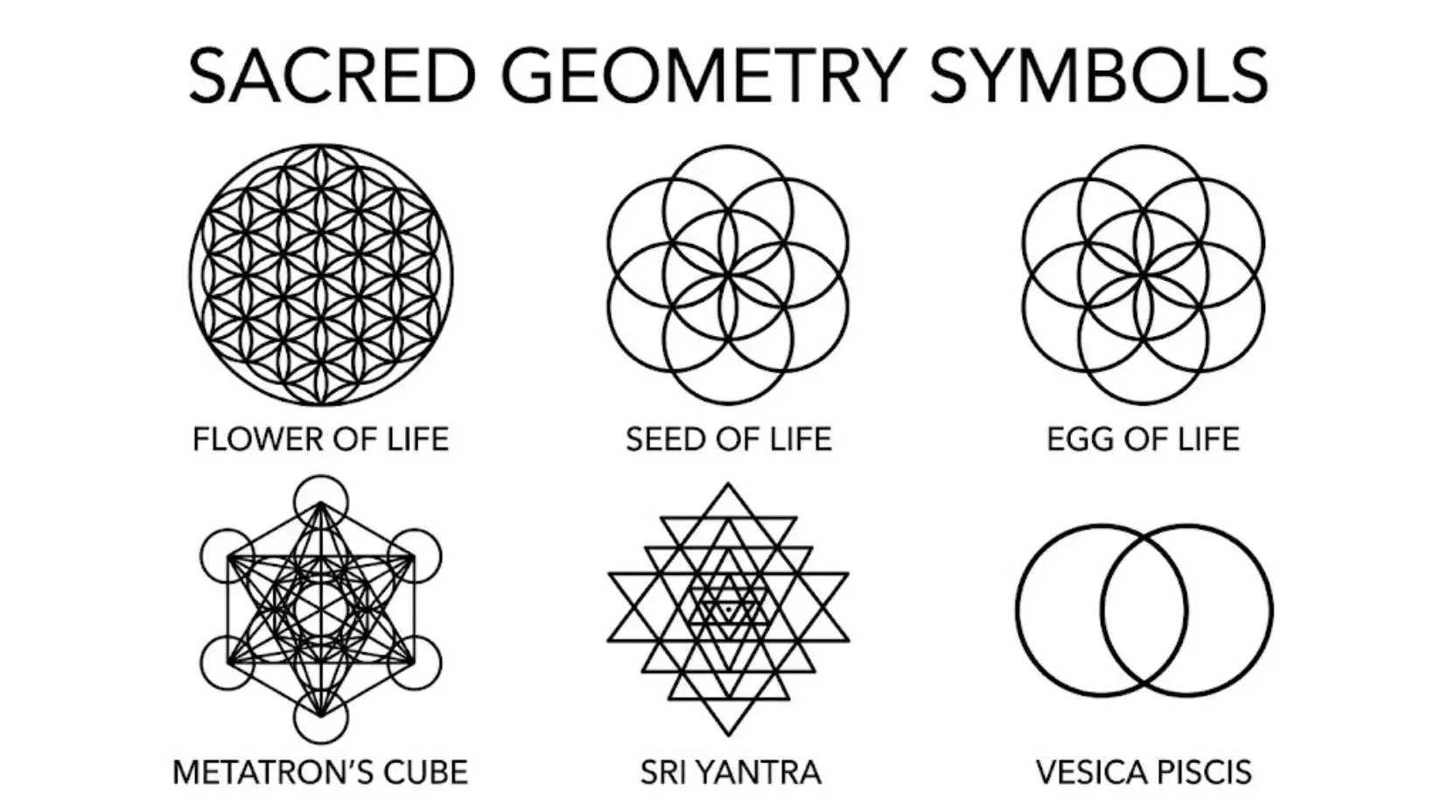
“Sacred geometry symbols” have captivated human imagination for thousands of years. From ancient temples and spiritual traditions to modern art and tattoos, these geometric patterns appear everywhere.
They are more than beautiful designs. Many people believe they reveal the hidden structure of the universe and the connection between nature, mathematics, and consciousness. Have you ever looked at a perfectly symmetrical pattern and felt an unexplained sense of peace?
Sacred geometry symbols often create that feeling. They seem familiar, almost as if they speak a universal language that exists beyond words.
Across cultures, religions, and civilizations, these symbols have represented creation, balance, harmony, and spiritual growth. In this guide, you’ll discover their meanings, origins, cultural significance, and why they continue to inspire people around the world.
Quick Answer
Sacred geometry symbols are geometric patterns and shapes believed to reflect the fundamental design of the universe. Common sacred geometry symbols include the Flower of Life, Seed of Life, Metatron’s Cube, Sri Yantra, Vesica Piscis, and Merkaba. These symbols represent harmony, creation, spiritual awakening, interconnectedness, and the balance between physical and spiritual existence.
What Makes Something a Sacred Geometry Symbol?
A sacred geometry symbol is more than a simple shape. It combines mathematics, symmetry, and symbolic meaning in a way that reflects natural patterns found throughout life.
Many sacred geometry symbols share these characteristics:
- Perfect proportions
- Repeating patterns
- Symmetry and balance
- Mathematical relationships
- Connections to nature
- Spiritual significance
These symbols appear in:
- Snowflakes
- Honeycombs
- Flowers
- Galaxies
- Shells
- Ancient architecture
The reason they feel meaningful is that the human brain naturally recognizes patterns. Psychologically, symmetrical designs create feelings of order, stability, and beauty. This may explain why sacred geometry has remained important across generations.
Sacred Geometry Symbols and Their Meanings
Flower of Life
The Flower of Life is one of the most recognized sacred geometry symbols in the world.
It consists of overlapping circles arranged in a repeating pattern. This design has been found in ancient Egyptian temples, medieval churches, and spiritual artwork from many cultures.
Meaning of the Flower of Life
The Flower of Life symbolizes:
- Creation
- Unity
- Infinite possibilities
- Interconnectedness
- Universal consciousness
Many spiritual practitioners believe it contains the blueprint of all living things.
Seed of Life
The Seed of Life is created from seven overlapping circles.
It is considered the foundation of the Flower of Life and represents the beginning of creation.
Spiritual Meaning
The Seed of Life symbolizes:
- New beginnings
- Growth
- Fertility
- Creative energy
- The stages of creation
Many people use this symbol during periods of personal transformation.
Metatron’s Cube
Metatron’s Cube is a complex geometric figure derived from the Flower of Life.
It contains multiple interconnected lines and shapes, including all five Platonic solids.
Symbolic Meaning
Metatron’s Cube represents:
- Divine order
- Protection
- Balance
- Spiritual wisdom
- Universal structure
Many people view it as a powerful symbol of sacred knowledge.
Sri Yantra
The Sri Yantra is one of the most important sacred geometry symbols in Hindu traditions.
It consists of nine interlocking triangles surrounding a central point.
Meaning
The Sri Yantra symbolizes:
- Cosmic energy
- Spiritual enlightenment
- Inner harmony
- Divine feminine power
- Manifestation
It is widely used during meditation and spiritual practices.
Vesica Piscis
The Vesica Piscis forms when two circles overlap.
This simple yet powerful shape appears in religious art, sacred architecture, and ancient symbolism.
Symbolic Interpretation
It represents:
- Creation
- Duality
- Unity
- Birth
- The meeting of opposites
Many scholars consider it one of the oldest sacred geometric patterns.
Merkaba
The Merkaba consists of two interlocking tetrahedrons.
Its star-like appearance symbolizes movement and energy.
Spiritual Meaning
The Merkaba represents:
- Ascension
- Spiritual protection
- Higher consciousness
- Balance of masculine and feminine energy
- Transformation
Many meditation practices incorporate this symbol.
Sacred Geometry Symbols Found in Nature
Nature is one of the greatest teachers of sacred geometry.
Spiral Patterns
Spirals appear in:
- Seashells
- Hurricanes
- Galaxies
- Ferns
The spiral symbolizes:
- Evolution
- Expansion
- Growth
- Life cycles
Hexagons
Hexagonal structures appear in:
- Honeycombs
- Snowflakes
- Crystal formations
The hexagon represents:
- Efficiency
- Harmony
- Cooperation
- Natural intelligence
Fibonacci Sequence
The Fibonacci pattern appears throughout nature.
Examples include:
- Sunflowers
- Pinecones
- Roses
- Hurricanes
This sequence symbolizes:
- Natural perfection
- Growth
- Universal order
- Beauty
Tree Branching Patterns
Trees follow geometric principles through their branching structures.
These patterns symbolize:
- Connection
- Wisdom
- Family
- Personal growth
Objects and Shapes That Represent Sacred Geometry
Many everyday objects reflect sacred geometry principles.
Circle
The circle symbolizes:
- Infinity
- Unity
- Wholeness
- Completion
It is one of the most universal sacred shapes.
Triangle
Triangles represent:
- Stability
- Strength
- Spiritual ascension
- Balance
Different cultures often associate triangles with divine power.
Square
The square symbolizes:
- Structure
- Security
- Foundation
- Physical reality
Ancient builders frequently used square designs in sacred architecture.
Sphere
The sphere represents:
- Perfection
- Unity
- Cosmic wholeness
- Divine creation
Many spiritual traditions consider it the ultimate symbol of completeness.
Cultural Sacred Geometry Symbols Around the World
Ancient Egypt
Egyptians incorporated sacred geometry into:
- Pyramids
- Temples
- Tombs
These structures reflected beliefs about cosmic harmony and eternal life.
India
Indian spiritual traditions developed some of the world’s most advanced sacred geometric systems.
Examples include:
- Sri Yantra
- Mandalas
- Temple layouts
These symbols support meditation and spiritual awakening.
Ancient Greece
Greek philosophers studied geometry as a pathway to understanding reality.
They explored:
- Platonic solids
- Mathematical harmony
- Universal patterns
Their discoveries continue to influence modern science and spirituality.
Africa
African cultures use geometric patterns in:
- Textiles
- Architecture
- Tribal art
These designs often symbolize ancestry, community, and spiritual protection.
Native American Traditions
Many Native American symbols feature sacred geometric principles.
Common examples include:
- Medicine wheels
- Circular village layouts
- Sacred hoop designs
These patterns emphasize balance and connection with nature.
Europe
European cathedrals frequently contain sacred geometric designs.
Builders used geometry to express:
- Divine order
- Spiritual truth
- Cosmic harmony
Many stained glass windows display intricate geometric symbolism.
Spiritual Meaning and Deeper Interpretation of Sacred Geometry Symbols
Sacred geometry symbols are often viewed as bridges between the physical and spiritual worlds.
Connection to Universal Energy
Many spiritual traditions teach that geometric patterns reflect the underlying structure of existence.
People use these symbols to:
- Enhance meditation
- Improve focus
- Promote inner peace
- Deepen spiritual awareness
Balance and Harmony
Sacred geometry teaches that balance exists throughout nature.
These symbols remind us that:
- Opposites can coexist
- Order exists within chaos
- Life follows natural rhythms
Personal Transformation
Many individuals associate sacred geometry with self-discovery.
The symbols encourage:
- Reflection
- Growth
- Healing
- Spiritual evolution
Psychological Impact
Research into visual perception shows that humans respond positively to symmetry and patterns.
Sacred geometry symbols often evoke feelings of:
- Calmness
- Wonder
- Stability
- Inspiration
This emotional response helps explain their enduring popularity.
Sacred Geometry Symbolism in Literature and Culture
Writers, artists, and philosophers have long used sacred geometry symbols to communicate deeper truths.
Literature
Authors often use geometric symbolism to represent:
- The search for meaning
- Spiritual journeys
- Hidden knowledge
- Universal order
Sacred geometric themes appear in mythology, religious texts, and modern fiction.
Art
Artists use geometric patterns to create visual harmony.
Examples include:
- Renaissance paintings
- Islamic art
- Contemporary designs
- Abstract artwork
Architecture
Many famous structures feature sacred geometry.
Examples include:
- Temples
- Cathedrals
- Monuments
- Meditation spaces
These designs create feelings of awe and spiritual connection.
Sacred Geometry Symbols in Everyday Life
You may encounter sacred geometry more often than you realize.
Home Decor
Popular examples include:
- Wall art
- Rugs
- Decorative patterns
- Crystal grids
Many people believe these designs create a peaceful atmosphere.
Jewelry
Sacred geometry jewelry often features:
- Flower of Life pendants
- Merkaba necklaces
- Sri Yantra charms
Wearers may choose them for spiritual or personal reasons.
Logos and Branding
Many companies use geometric principles because they communicate:
- Balance
- Trust
- Simplicity
- Professionalism
Meditation Practices
Sacred geometry symbols frequently serve as visual focus points during meditation.
People use them to improve concentration and mindfulness.
Universal Sacred Geometry Symbols Recognized Worldwide
Some sacred geometry symbols have achieved global recognition.
Top Universal Symbols
Flower of Life
Represents universal creation and interconnectedness.
Sri Yantra
Symbolizes spiritual awakening and divine energy.
Metatron’s Cube
Associated with sacred knowledge and protection.
Vesica Piscis
Represents creation and unity.
Spiral
Symbolizes growth and evolution.
Circle
Represents infinity and wholeness.
These symbols transcend cultural boundaries and continue to inspire people worldwide.
Sacred Geometry Tattoo Ideas and Personal Meanings
Sacred geometry tattoos have become increasingly popular because they combine beauty with profound symbolism.
Flower of Life Tattoo
Perfect for people who value:
- Unity
- Connection
- Personal growth
Metatron’s Cube Tattoo
Often chosen by those seeking:
- Protection
- Wisdom
- Spiritual development
Merkaba Tattoo
Represents:
- Transformation
- Balance
- Higher consciousness
Mandala Tattoo
Popular for symbolizing:
- Peace
- Inner harmony
- Self-discovery
Sacred Spiral Tattoo
Represents:
- Personal evolution
- Progress
- Life’s journey
Before choosing a tattoo, consider the symbol’s cultural and spiritual significance to ensure it aligns with your intentions.
How to Create or Draw a Sacred Geometry Symbol?
Creating sacred geometry can be both relaxing and meaningful.
Step 1: Gather Materials
You’ll need:
- Compass
- Pencil
- Ruler
- Paper
- Eraser
Step 2: Start With a Circle
Most sacred geometry symbols begin with a single circle.
The circle represents unity and infinite potential.
Step 3: Add Symmetrical Shapes
Use the compass to create repeating circles and patterns.
Focus on:
- Accuracy
- Balance
- Symmetry
Step 4: Build Complexity
Gradually add:
- Triangles
- Hexagons
- Intersections
These elements create the structure of the symbol.
Step 5: Reflect on the Meaning
Many practitioners view drawing sacred geometry as a mindful activity.
Take time to consider what the symbol represents in your life.
Frequently Asked Questions
What are sacred geometry symbols?
Sacred geometry symbols are geometric patterns believed to represent the fundamental structure of the universe. They combine mathematics, spirituality, and natural design.
What is the most powerful sacred geometry symbol?
Many people consider the Flower of Life one of the most powerful symbols because it represents creation, unity, and interconnectedness.
Are sacred geometry symbols religious?
Not necessarily. While many religions use sacred geometry, these symbols also appear in science, nature, art, and philosophy.
Why do people use sacred geometry in meditation?
The balanced patterns help improve focus, encourage mindfulness, and create a sense of inner calm.
What does the Flower of Life symbolize?
The Flower of Life symbolizes creation, harmony, unity, and the interconnected nature of all existence.
Can anyone use sacred geometry symbols?
Yes. People from many backgrounds appreciate these symbols for their artistic beauty, spiritual significance, and symbolic meaning.
Conclusion
Sacred geometry symbols have inspired humanity for thousands of years because they connect mathematics, nature, spirituality, and art in a powerful way. From the Flower of Life and Sri Yantra to spirals and hexagons found in nature, these symbols reveal patterns that appear throughout existence.
They offer lessons about balance, growth, unity, and transformation. Their beauty speaks to both the mind and the soul. As people continue searching for meaning and connection, sacred geometry remains a timeless source of wisdom and inspiration.
Related Posts:
- 65+ Best Florida State Symbols and the Fascinating Stories Behind Them
- 37+ Top Mayan Symbols From Sacred Glyphs to Powerful Spiritual Meanings
- 75+ Symbols of Christmas | Hidden Meanings, Traditions and Powerful Messages Behind Every Holiday Symbol

Ryan Scott is a dedicated writer and symbol researcher who uncovers the deeper meanings behind everyday signs and symbols. His work focuses on making complex symbolic concepts simple, engaging, and easy to understand for readers from all backgrounds.
He is the author of Hidden Symbol Codes and Secrets Behind Ancient Symbols, where he explores the origins and meanings of symbols across different cultures.
Ryan’s goal is to inspire curiosity and help readers see the world from a new perspective through the language of symbols.
 Sophia Bennett
 Andrew Clark